 ChipBuddy
← Home
ChipBuddy
← Home
The Multi-Bit Flip-Flop Flow
Why Bank Flip-Flops Together?
A multi-bit flip-flop (MBFF) is a single library cell that packs several individual flops into one physical structure that shares clock circuitry — most importantly a shared internal clock driver and, often, shared inverters for the local clock. Instead of each bit having its own clock pin buffered separately, a group of bits is served by one shared clock path. The payoff is power. The clock network is the busiest, most power-hungry net on the chip, and a large fraction of its load is the per-flop clock pins and the last-stage buffers driving them. By merging, say, four single-bit flops into one four-bit cell, you replace four clock-pin loads and four last-stage drivers with one shared structure. That cuts clock-tree capacitance, the number of leaf buffers, dynamic power, and often area.
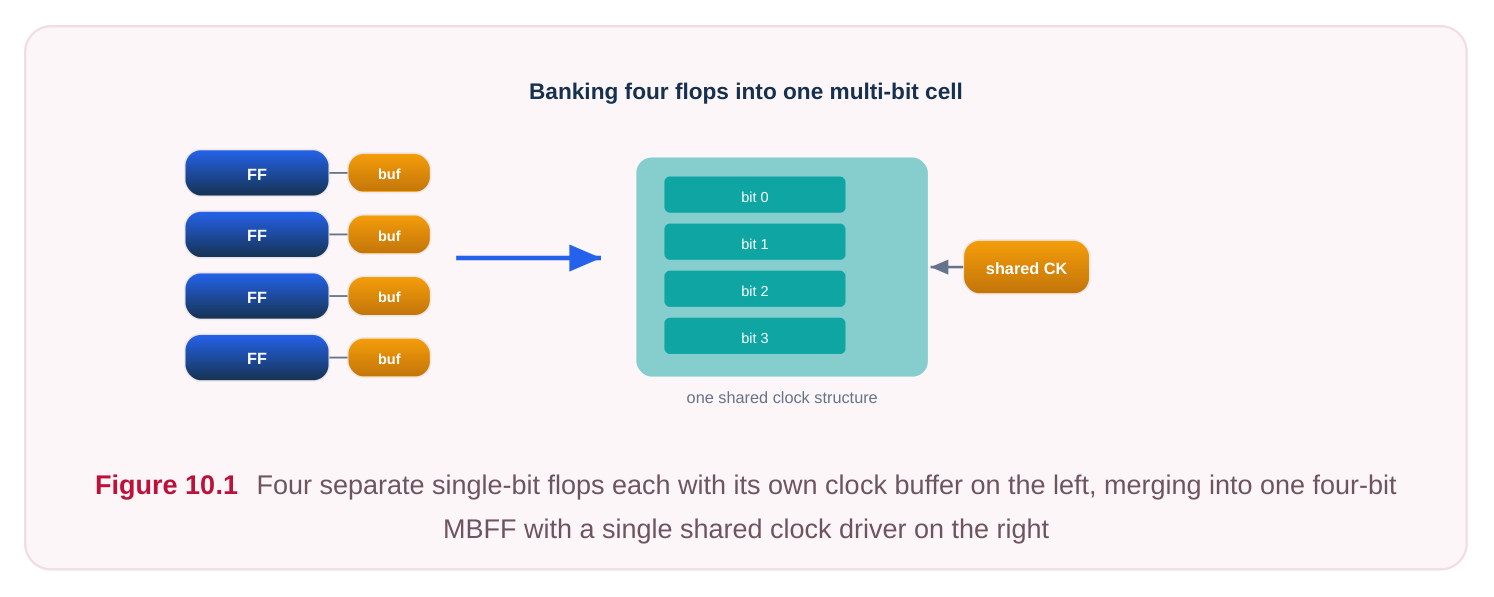
| Metric | Many single-bit flops | One multi-bit flop |
|---|---|---|
| Clock leaf load | one pin per bit | one shared structure |
| Last-stage buffers | one per bit | shared |
| Clock dynamic power | higher | lower |
| Area | higher (separate cells) | usually lower |
| Placement flexibility | per-bit | grouped (less freedom) |
The cost is flexibility: bits banked together must sit in one cell, so they lose independent placement and must share timing context. That is why MBFF is an optimization decision, not a default — you bank bits that genuinely benefit and leave others single.
The Multi-Bit Flow: Merge and De-Bank
There are two complementary operations:
- Merging (banking): combine compatible single-bit flops into a multi-bit cell.
- De-banking (splitting): break a multi-bit cell back into singles when banking hurts timing or placement. A good flow does both, iteratively, and at more than one point in the implementation. Candidates for merging are flops that are clock-compatible (same clock, same edge, same set/reset/enable structure, same operating context) and physically close (so the bank does not stretch the clock or data routing).
# Identify and merge compatible single-bit flops into multi-bit cells
# illustrative — generic, not tool-specific
merge_multibit -max_bits 4 -max_distance 15.0 -clock_compatible true
# Split a multi-bit cell back to singles where it hurts
# illustrative — generic, not tool-specific
split_multibit -instances [get_problem_banks]| Operation | When to use | Risk |
|---|---|---|
| Merge | clock-compatible, nearby flops | over-banking stretches routing |
| De-bank | a bank on a critical/congested spot | loses some power saving |
| Re-bank | after placement changes | churn |
Use model across the flow
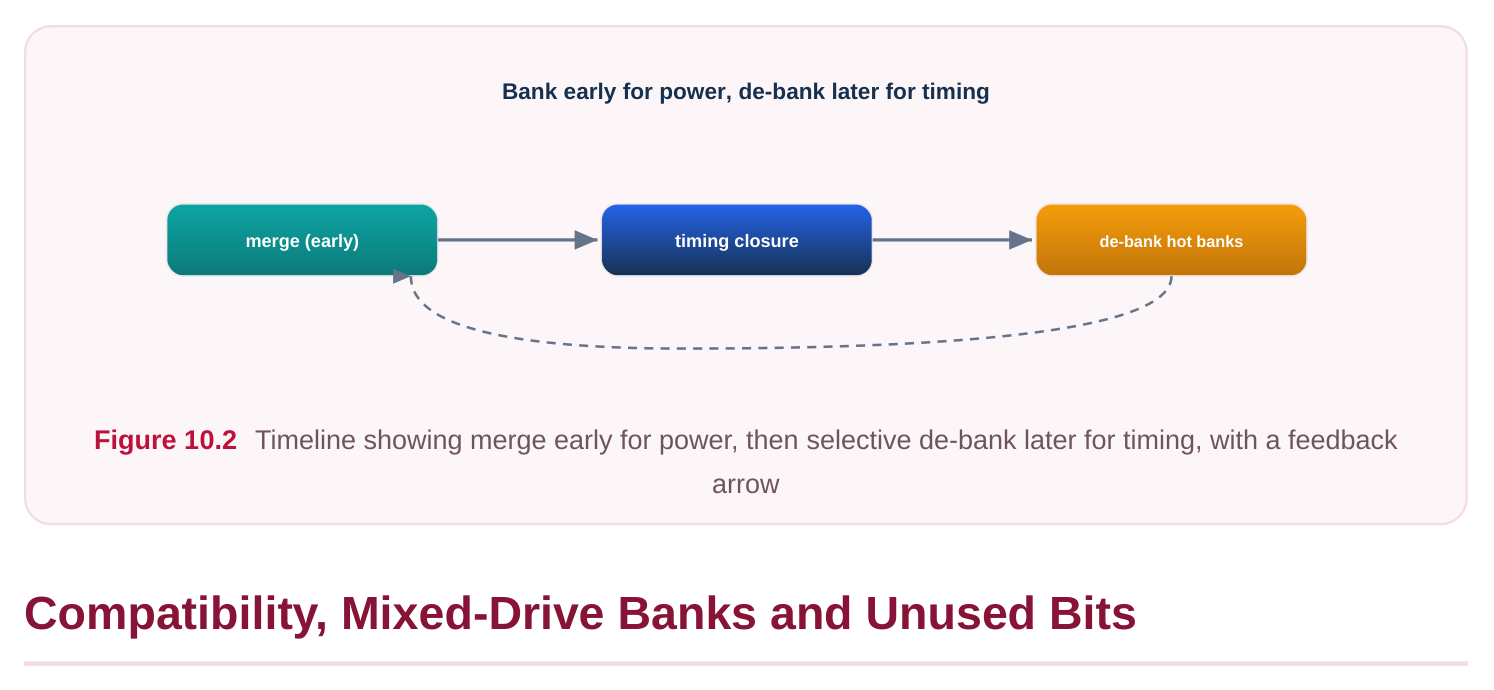
Banking decisions land differently depending on when they are made. Merging early (around synthesis/placement) maximizes power savings but risks later timing surprises; merging or de-banking later is safer but recovers less. A common model is to bank during early implementation, then de-bank selectively during timing closure where a bank sits on a critical path or in congestion.
Not every group of flops should become one cell. The flow checks several compatibility dimensions and offers refinements:
- Mixed-drive-strength banks: the bits in a bank may need different drive strengths (one bit drives a heavy load, another a light one). Reordering or choosing a mixed-drive multi-bit cell lets a single bank serve bits with different needs rather than forcing a one-size compromise.
- Merging with unused bits: if a four-bit cell is available but only three compatible bits exist nearby, the flow can still bank the three and leave the fourth slot unused — sometimes worthwhile for the shared-clock savings, sometimes wasteful; the optimizer weighs it.
- Multi-bit combinational cells: the same banking idea extends beyond flops to grouped combinational cells in some libraries.
- Multi-bit latches: latches can be banked too, with their own reporting.
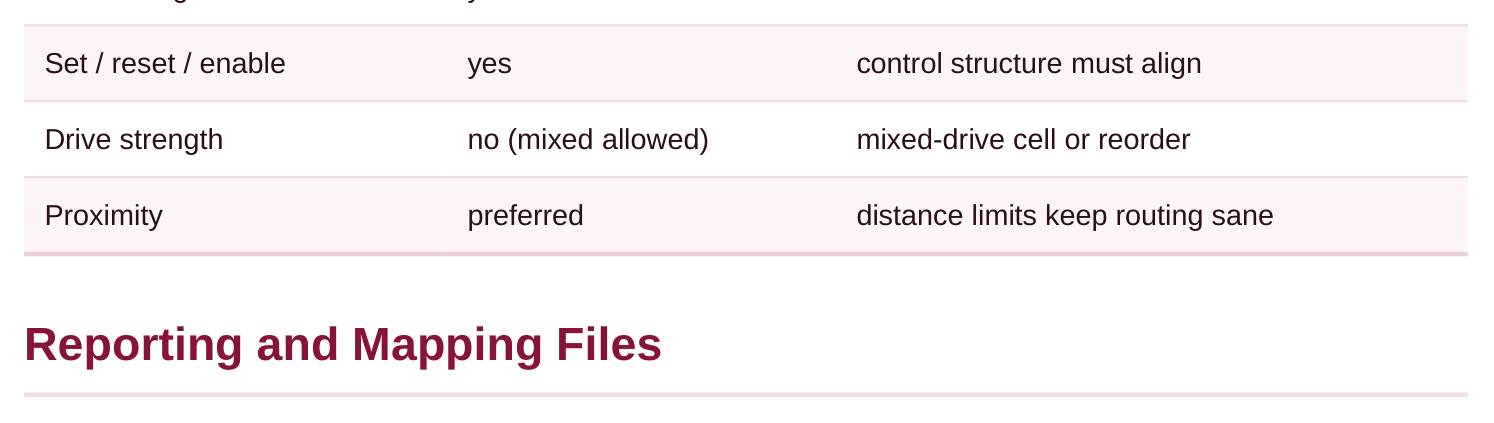
# Allow mixed-drive banks and report what was formed# illustrative — generic, not tool-specificmerge_multibit -allow_mixed_drive true -allow_unused_bits truereport_multibit -type flopreport_multibit -type latchCompatibility check Must match? Notes Clock / edge yes different clocks cannot bank
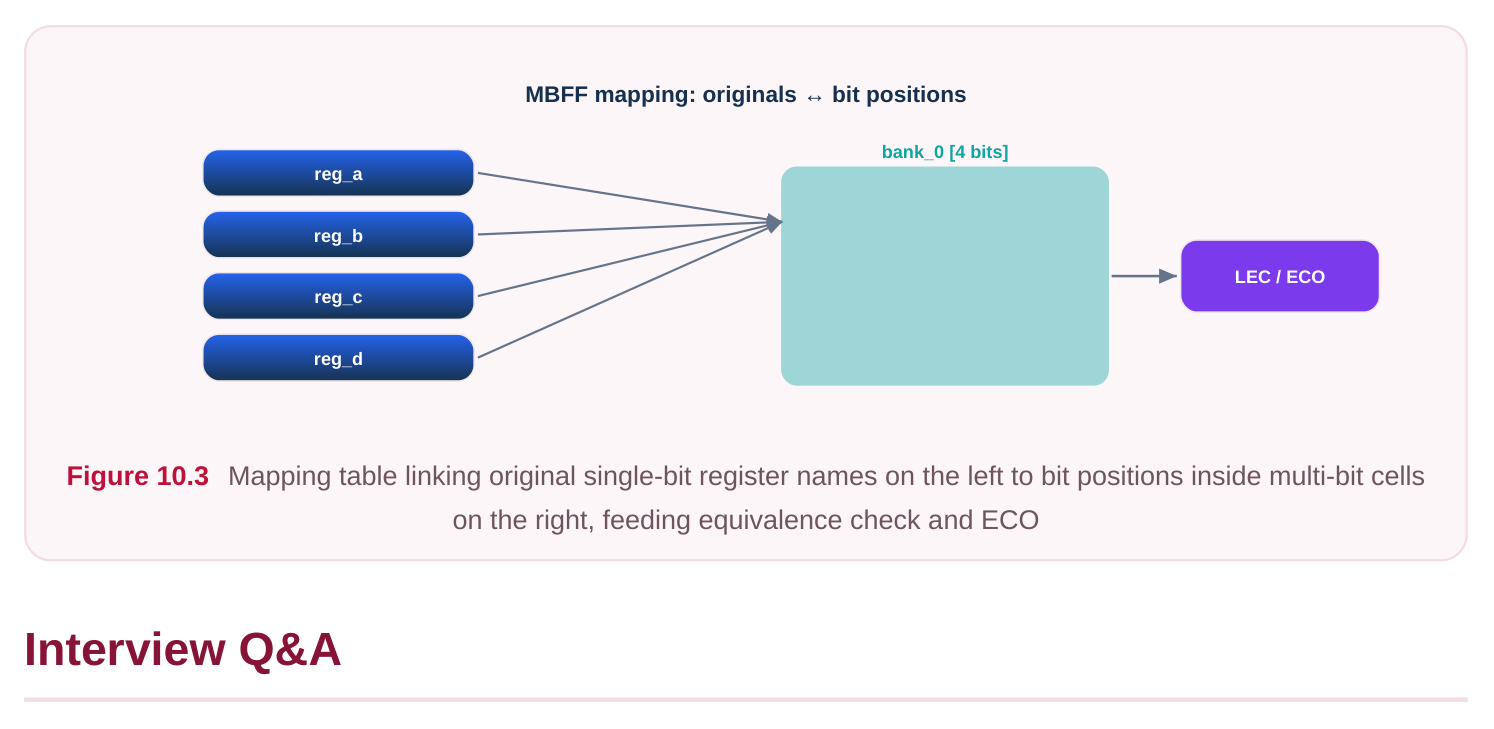
Because banking changes the netlist structurally, two kinds of records matter for downstream flows and equivalence checking:
- MBFF reports summarize how many banks were formed, of what widths, how many bits were left single, and the resulting clock-pin/power savings. The same reporting exists for multi-bit latches.
- Mapping files record how original single-bit instances correspond to bits inside multi-bit cells (and vice versa). These are essential so that formal equivalence checking, debug, and ECO can relate the banked netlist back to the original register names.
# Emit a summary and write the original<->banked mapping# illustrative — generic, not tool-specificreport_multibit -summarywrite_multibit_mapping multibit.map
across several bits, cutting clock-leaf load, last-stage buffer count, clock dynamic power, and usually area. The cost is placement flexibility: banked bits must occupy one cell and share context, so banking only the genuinely compatible, nearby flops is the discipline.
reset/enable structure — that are physically close enough that the bank does not stretch clock or data routing. Distance and compatibility limits guard against harmful banks.
back to singles restores independent placement and timing freedom. You give up some power savings to recover closure or routability — a worthwhile local trade.
longer exist as separate instances. The mapping file relates originals to bit positions in multi-bit cells, which equivalence checking, debug, and ECO need to reconcile the banked netlist with the source.
Key Takeaways
- A multi-bit flip-flop merges several bits behind shared clock circuitry, cutting clock-tree load, leaf buffers, dynamic power, and area.
- Bank only clock-compatible, nearby flops; the flow supports merge, de-bank, and re-bank across the flow.
- Refinements include mixed-drive banks, merging with unused bits, multi-bit latches, and multi- bit combinational cells.
- Bank early for power, de-bank selectively later for timing/congestion.
- Always emit MBFF reports and mapping files so equivalence checking, debug, and ECO can relate banked cells to original registers.
Comments
Leave a Reply