 ChipBuddy
← Home
ChipBuddy
← Home
How to Use This Bank
This is a fast question bank. It covers the basics that an STA interview almost always asks. Each answer is short. You should be able to say it out loud in about 25 seconds. Practice the reasoning, not just the words. The next chapter pushes into harder cases.
Concept Fundamentals
this without test inputs. It walks arrival times through the timing graph. Then it tests every path against setup and hold.
slow and misses paths. STA checks all paths fast, with no inputs. The trade-off: it checks timing only, not function.
It is only as good as your constraints, libraries, and parasitics.
time. For hold it is arrival minus required. Positive means it passes. Negative means it fails.
moves forward from startpoints. Required time is the latest (setup) or earliest (hold) the signal may arrive. It moves backward from endpoints.
For hold, it is the most at risk.
output. The last one is pure combinational. Each one is constrained in its own way.
endpoint is a register D pin or a primary output.
Delay and Slew
reads delay and output slew from 2-D tables. It interpolates between table points.
delay. It also makes timing more sensitive to variation. It worsens noise and power too. So STA sets a max-transition rule.
as a current source. It drives the real RC net. This captures waveform shape and resistive effects. A single delay table cannot do this at small nodes.
"sees" less than the total wire cap. Delay math uses this smaller value, not the full lump.
gives output rise. Negative-unate: input rise gives output fall. Non-unate: both, like an XOR. It sets which edges form timing arcs.
then distributed RC trees. Elmore delay gives the idea. Downstream resistance times cap builds up along the tree.
Setup and Hold
before the capture edge minus setup time. You also adjust for skew and uncertainty. This sets the top clock speed.
stable for the hold time. This stops a fast new value from racing through. It does not depend on the clock period.
period away. A shorter period makes it tighter. Hold looks at the same edge. The period cancels out. So hold depends only on skew and min delay.
than launch. This helps setup, since data has more time. It hurts hold, since data can race through. Negative skew does the opposite.
depend on the period. A longer period does nothing. Fix hold with delay buffers, less skew, or slower min-delay cells.
release. Recovery is like setup. Removal is like hold. Together they make the flop exit reset cleanly.
Clocks and Constraints
synchronous check is measured against it.
clock-definition point. Network latency is the delay through the on-chip clock tree to the register. Added together they give total latency.
with uncertainty for skew and jitter. A propagated clock uses real tree delays after CTS. It gives true skew.
skew, jitter, and extra guardband before the real tree exists. It tightens both setup and hold. Real skew mostly replaces it after CTS.
source or PLL. It eats margin, mostly setup. It is part of uncertainty.
it wrong and the tool picks wrong capture edges. The slack then makes no sense.
against a clock. They say how much of the period is used outside the chip. Max values drive setup. Min values drive hold.
external clock that is not a real port here.
loads at the edge are realistic. Without it, boundary path delays are wrong.
good constraint review flags any uncovered endpoints.
Exceptions
mutually exclusive modes. Declaring it drops false violations. The tool then does not over-design.
The trap: a setup multicycle of N moves the capture edge out. But the default hold check lands on the wrong edge. You must add a matching hold multicycle, usually N−1, to pull it back.
ignores clock-derived limits. It is common for I/O or async datapaths.
a mode. It speeds analysis and drops impossible paths.
happens on paths that share its scope. Always declare the narrowest correct exception.
Variation and Corners
spread. Libraries are characterized for each corner.
voltage, hot. Hold is usually worst at fast process, high voltage, cold. Watch the temperature-inversion exception at low voltage.
This is the opposite of the usual trend. So "hot equals slow" breaks. You must check both temperature extremes.
derate slows data for setup. An early derate speeds it for hold.
in speed. It applies opposite derates. It is simple but pessimistic.
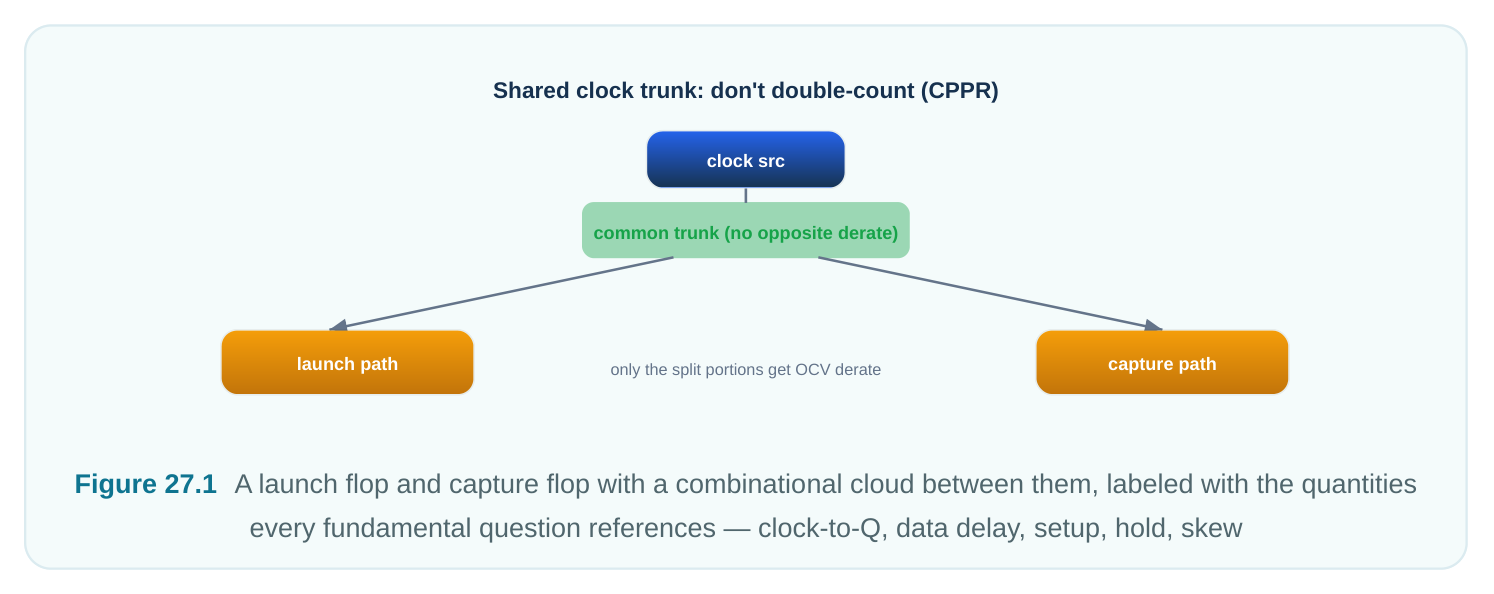
get opposite derates. Removing that double count gives back large, false-looking slack.
sign off on the worst across all active scenarios.
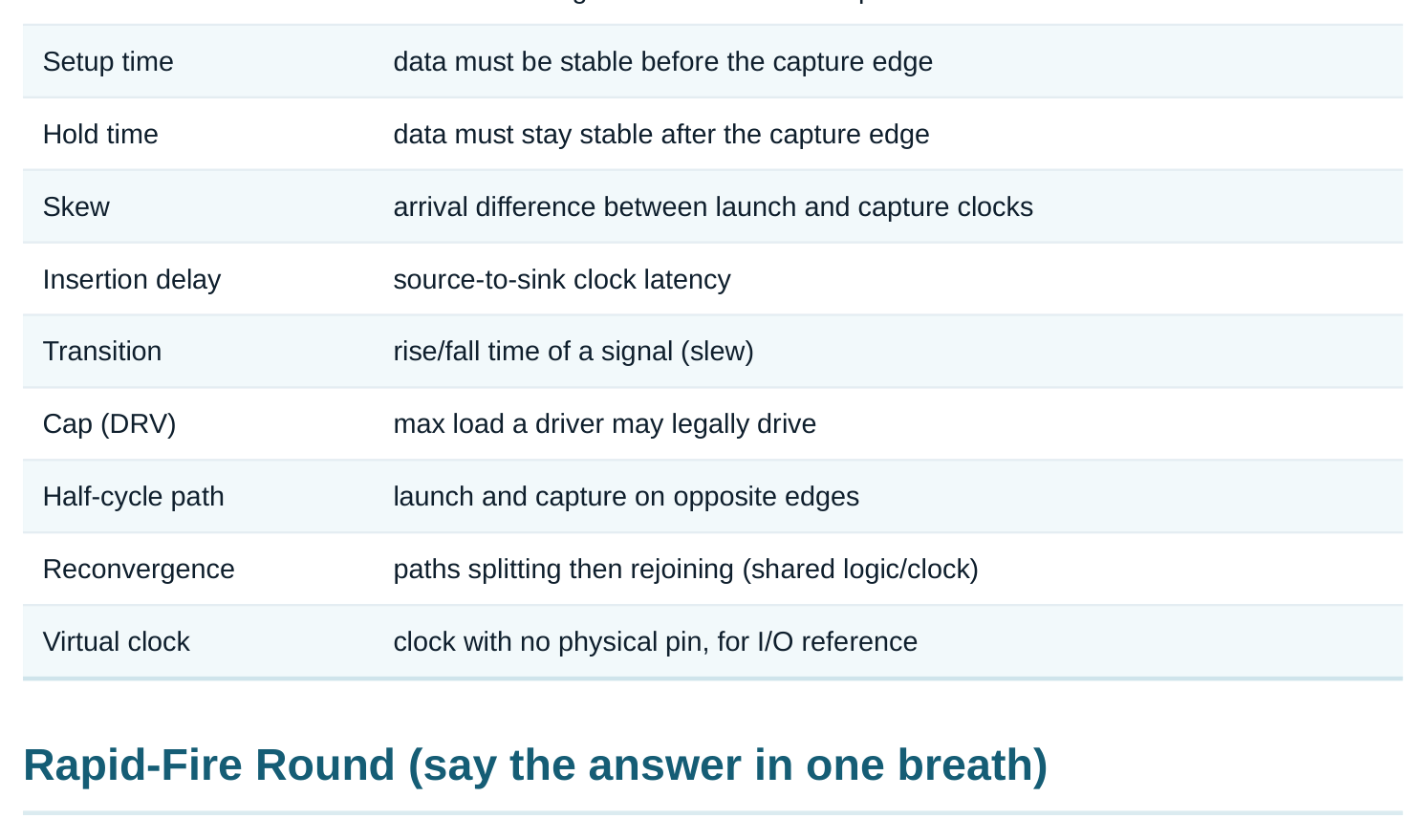
Quick-Fire Definitions
Interview Q&A Bank — Fundamentals
| Term | One-line answer |
|---|---|
| WNS / TNS | worst / total negative slack across endpoints |
is fixed by skew + min delay, setup or hold? Hold. Q45. Where does effective capacitance come from? The net shields the far cap from the driver. Q46. What removes shared-clock pessimism? CPPR. Q47. Up-shifter is needed when a signal goes from…? A lower-voltage domain to a higher one. Q48. What does a false path tell the tool? That the path is never active — do not check it. Q49.
What metric captures total design setup health? TNS, with WNS for the worst single path. Q50. Propagated clock is used when? After CTS, when real tree delays exist.
Key Takeaways
- Be able to define and derive setup and hold. Explain why setup scales with frequency but hold does not.
- Know the clock vocabulary cold: latency, uncertainty, skew, jitter, ideal vs propagated, generated clocks.
- Explain constraints and exceptions clearly, including the multicycle hold trap and the danger of over-constraining.
- Cover corners, derating, OCV, CPPR, and MCMM. Know which corner is worst for setup vs hold, and temperature inversion.
- Practice answering in about 25 seconds with reasoning, not just definitions.
Comments
Leave a Reply