 ChipBuddy
← Home
ChipBuddy
← Home
Why Timing Constraints Exist
What a Timing Constraint Actually Is
A timing constraint is an instruction that tells a tool how fast a chip must run. It is written in the SDC constraint format. SDC is a plain-text file full of commands. Each command states one timing fact about the design. A chip is built from logic gates and flip-flops. A flip-flop (a tiny storage cell that captures a value on a clock edge) only works correctly if data arrives on time. The clock (the repeating square wave that paces the design) sets the rhythm. Constraints describe that rhythm and the timing rules around it. Without constraints, a tool sees only gates and wires. It does not know how fast you want them to switch. It does not know which signals are clocks. It does not know how the chip connects to the outside world. Constraints supply all of that intent. Think of constraints as the timing spec, separated from the logic spec. The logic spec (the RTL, or register-transfer-level code) says what the chip computes. The SDC says how fast it must compute, and under what timing rules.
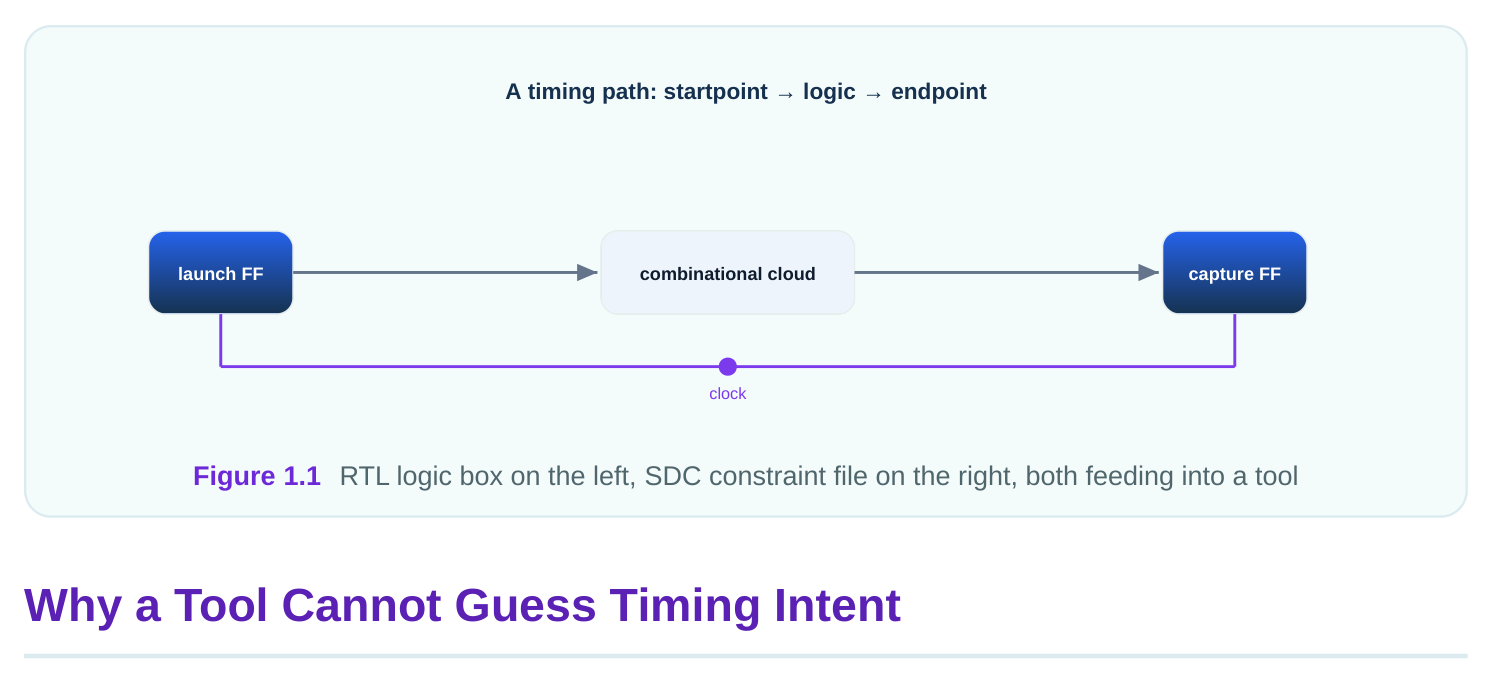
A tool reads your logic, but logic alone hides timing intent. Two designs can look identical in gates yet need very different timing. One might target 2.5 ns per cycle. Another might target 8.0 ns. The gates do not say which. The clock is the clearest example. A clock signal looks like any other wire to the tool. It toggles, it drives flip-flops, but nothing in the netlist marks it as "the clock." You must declare it. Until you do, the tool treats every path as if timing does not matter. Interface timing is also invisible. The tool cannot know when an outside chip sends data to your input pins. It cannot know when an outside chip expects your output pins to be ready. That schedule lives in a system spec, not in the gates. You translate it into constraints. Exceptions are intent too. Some paths are never used at the same time. Some paths are allowed several cycles to finish. The tool cannot infer these. A path that looks slow might be perfectly fine because it only needs to settle every fourth cycle. Only you know that.
| Timing fact | Visible in gates? | Must be a constraint? |
|---|---|---|
| Which wire is the clock | No | Yes |
| Target clock speed | No | Yes |
| When inputs arrive | No | Yes |
| When outputs are needed | No | Yes |
| Paths that never race | No | Yes |
| Paths allowed extra cycles | No | Yes |
The Cost of Wrong or Missing Constraints
Missing constraints cause silent failures. If you forget to declare a clock, the tool ignores timing on that whole clock's logic. It will not optimize those paths. The chip may run far slower than intended, and reports will look clean because nothing was being checked. Wrong constraints cause the opposite trap: false confidence. If you tell the tool the clock period is 6.4 ns when the real target is 3.2 ns, every report passes. Then the chip fails on the bench. The numbers were green, but they measured the wrong target. Constraint mistakes are expensive because they surface late. A clock typo might pass synthesis, pass place-and-route (the step that arranges gates and routes wires), and only break at sign-off (the final timing check before manufacturing) or, worse, in silicon. By then a fix can mean a new fabrication run costing months and large sums of money.
Here is a simple feel for how a period error distorts slack. Slack is how much a timing check passes by; positive is good.
# worked example — effect of a wrong clock period
Real required arrival (correct 3.2 ns target):  3.2 ns
Actual data arrival at the flip-flop:           3.5 ns
Correct slack = 3.2 - 3.5 = -0.3 ns  (FAILS)
If period is mis-set to 6.4 ns:
Wrong required arrival:                          6.4 ns
Reported slack = 6.4 - 3.5 = +2.9 ns  (looks fine, but it lies)
The path truly fails by 0.3 ns. The bad constraint hides it as a comfortable 2.9 ns pass.
Constraints as a Contract
It helps to read constraints as a contract between teams. The architecture team promises a clock speed and an interface schedule. The SDC writes that promise down in a form every tool obeys. Each tool in the flow then honors the same contract.
A contract has two sides. The design side promises to meet the timing. The constraint side promises to describe the real requirement, no more and no less. If either side lies, the chip is at risk. Because the same SDC is reused at synthesis, place-and-route, and sign-off, the contract stays consistent. One source of truth keeps every step aligned. If the contract changes, you change one file and rerun, instead of editing settings buried in many tools.
# standard SDC — portable across compliant tools
# A minimal contract: one clock, one input timing, one output timing
create_clock -name sys_clk -period 3.2 [get_ports clk_in]
set_input_delay  -clock sys_clk 1.15 [get_ports data_in]
set_output_delay -clock sys_clk 0.85 [get_ports data_out]
These three lines say: run at 3.2 ns, expect input data 1.15 ns into each cycle, and have output data ready 0.85 ns before the cycle ends. That is a clear, testable promise.
Over-Constraining vs Under-Constraining
There are two ways to get the contract wrong. Under-constraining leaves out requirements. Overconstraining demands more than the system needs. Both waste effort or cause failures. Under-constraining is the more dangerous one. Forgotten clocks, missing input or output delays, and unchecked paths all let real problems slip through. The reports stay green because nothing is being measured. You only learn the truth much later. Over-constraining is safer but costly. If you set the period to 2.8 ns when 3.2 ns is enough, the tool works harder than needed. It adds bigger gates and more buffers (cells that strengthen a signal). The result burns more power and area to chase timing that was never required. A common over-constraint is padding interface delays "to be safe." A little margin is wise. Too much forces the tool to over-build the interface logic. The chip becomes larger and hotter for no real benefit.
| Problem | What you do | Main risk |
|---|---|---|
| Under-constrained | Leave out a clock or delay | Real failures hidden, found late |
| Over-constrained | Demand tighter than needed | Wasted power and area |
| Well-constrained | State the true requirement | Honest reports, efficient chip |
The goal is honesty. State the real requirement exactly. The chip then gets exactly the effort it needs, and the reports tell the truth.
intent. The same gates can target 2.5 ns or 8.0 ns, and nothing in the netlist says which. The tool also cannot know which wire is the clock or when external data arrives. You must declare all of that in the SDC.
then ignores timing on that clock's entire logic, so it never optimizes those paths and never reports a failure. The chip can be far too slow while reports look perfectly clean.
target. If the period is set to 6.4 ns but the real goal is 3.2 ns, a path failing by 0.3 ns shows as a +2.9 ns pass. The reports are green because they measured the wrong requirement.
speed and interface timing that every tool in the flow obeys. The architecture team supplies the requirement; the SDC records it faithfully. The same file is reused at synthesis, place-and-route, and sign-off so all steps stay aligned.
because it hides real failures behind clean reports. Over-constraining is safer but wasteful: it makes the tool add bigger gates and extra buffers, burning more power and area than needed.
and place-and-route, then break only at sign-off or in silicon. A silicon-stage fix can mean a new fabrication run costing months and large amounts of money.
Key Takeaways
- A timing constraint is an instruction in the SDC format that tells a tool how fast a chip must run and under what timing rules.
- Tools cannot guess timing intent: clocks, target speed, interface timing, and exceptions are all invisible in gates and must be declared.
- Missing constraints hide failures behind clean reports; wrong constraints create false confidence that breaks late.
- Treat the SDC as a contract: one source of truth, reused across synthesis, place-and-route, and sign-off.
- Aim for honesty: under-constraining hides real bugs, over-constraining wastes power and area, and stating the true requirement gives an efficient chip.
Comments
Leave a Reply